

When Passion Makes You Feel Like an Outsider
The isolation of caring deeply — and why it’s also how you find your people.

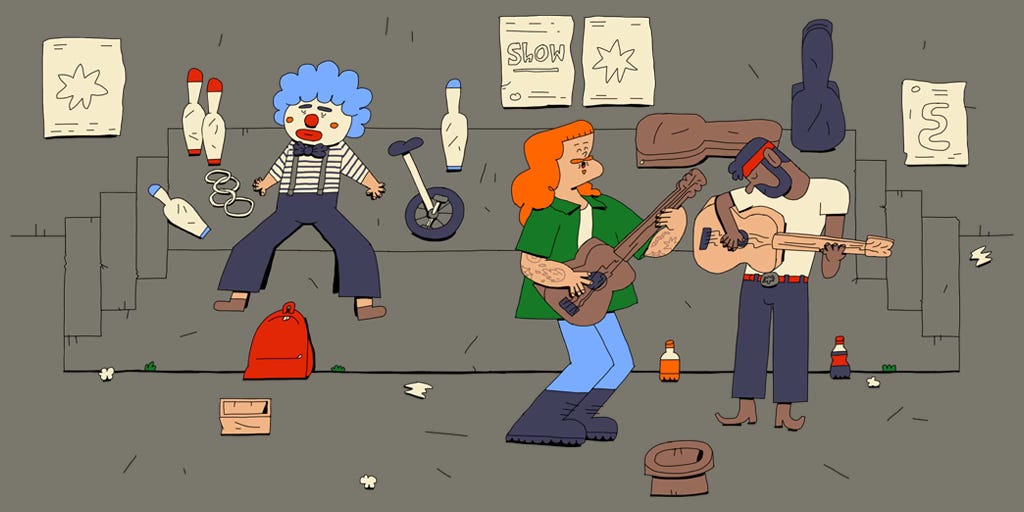
“Excellence is lonely. Your friends won’t get it, but your allies will.” — Tim Grover
The other day, I was throwing my gear into my gym bag for my second jiu-jitsu class of the day when a friend texted me: “Want to get dinner?”
I stared at the screen, knowing the answer before I even typed it.
I had training tonight. Writing early in the morning.
I had a whole life built around the things I love most — which means I miss almost everything else.
It’s something I’ve noticed in both my own life and in the eighty-plus passionate people I’ve interviewed for On Fire: when you fall deeply in love with something, two things happen at once.
First, you drift out of sync with the world. And second, paradoxically, you find your people.
Obsessed but Lonely
Every deeply passionate person knows this: passion can be lonely.
When you care about something with your whole being, you start slipping out of sync with the rest of the world. I was reminded of this recently while rereading The Art of Fielding, one of the greatest novels ever written about mastery. Chad Harbach captures the stark divide between elite baseball players and the average college kid: protein shakes instead of beers, 5am runs instead of late-night parties, every hour shaped around practice and study and preparation.
Many passionate people live this contrast every day. When you build your life around a passion, you start making decisions that don’t make sense to anyone else. You give up spontaneity in favor of practice. You create strict boundaries around your creative time. And suddenly you’re the intense one. The obsessive one. The one who “could really use a little more balance.”
Friends and family don’t always say it outright, but the message is clear: be more normal.
I hear this pattern constantly. “I’ve heard it my whole life,” Cara Bradley told me. “Too driven. Too enthusiastic. Too ambitious.” Or as Dian Killian put it: “My enthusiasm can sometimes be overwhelming for people.”
I’ve felt this too. More than one person has told me I operate like a Ferrari in a world cruising at a different speed. Sometimes it feels powerful. Other times, I just wish I could blend in.
It’s no wonder passionate people often feel like aliens, living in a different emotional climate than the people around them.
Passion Helps You Find Your People
Yet this is the part we often forget: the very intensity that isolates us is also the bridge to belonging. As lonely as passion can be, nothing compares to the feeling of meeting someone who loves the same strange, specific thing you do.
When I spoke to Matt Conwell, the creator of PDXLAN, he told me how lonely he’d been as a kid. He was bullied often, so he hid in video games. It wasn’t until a college assignment sparked an idea — what if he brought gamers together for a weekend-long event? — that something shifted.
He realized he could build the community he never had. “I created PDXLAN to be the thing I always wanted as a kid,” he told me. “We have fun together. It’s like camp.” He didn’t just find his people; he created a world for them to belong.
Again and again, I hear the same thing. “All my friends are pickleball players now,” Steve Paranto told me, after fifty years of competing. “It’s all about the people,” robotics engineer Ross Hatton insisted. Passion gives people a community that feels like home — people who understand them in a way their “regular life” often doesn’t.
There are a few reasons this happens.
First, passion gives us something to talk about. I can’t stand small talk — those “where are you from” or “how old is your dog” conversations make me want to bolt — but put me around jiu-jitsu people and we can dissect guard variations or escapes for hours. It’s freeing.
Second, passion lets us connect over shared struggle: bruises, aches, creative blocks, fear, frustration, plateaus. Outsiders only see the shiny end result. Inside a passion community, you see everything.
And finally, passion creates fast friendships. Think about the last time you met someone who loved the same niche thing you do — roller skating, oil painting, chess. Bonding happens immediately because the love of the thing is already there.
There’s research behind this too. Shared challenge builds cohesion. Individual flow can transform into what anthropologist Victor Turner identified as communitas — the profound sense of merging with others in joint attention. Social psychologists call it self-expansion. Neuroscientists call it attunement. But passionate people know it simply as this: when you care deeply about something and find others who care too, you belong.
Passions also give us a reason to connect regularly — something increasingly rare in adult friendships. My friend Martin Dasko started a Friday night soccer league partly just to see his friends more often. “Now we hang out every Friday, no matter what,” he told me. He’s a perfect example of someone structuring his life around the things he loves. He estimates he spends about twenty hours a week doing activities he enjoys with people who love them too.
This is why connecting through passions may be one of the most reliable antidotes to loneliness. But the full picture is nuanced. In one sense, finding a passion can make you more isolated; in another, it can make you profoundly less so. The truth is both.
But I’d argue that the benefits of adopting a passion — the learning, the growth, the feeling of being understood by people on your wavelength — far outweigh the downsides.
People often think passions are personal, even selfish. But they’re deeply relational. They can make us feel like we’re operating on a parallel frequency to the world around us. And they can bring us into community with the people tuned to that same frequency.
Because at the end of the day, passion doesn’t just help you find what you love. It helps you find who you belong to.
Thanks so much for your lovely, epic and thoughtful article, Ms. Stryker! I really appreciate the understanding, especially about attunement and self-expansion. Passion really does bring you along the best path of life that brings out a strong sense of belonging. I know it all too well nowadays, based on being connected with people here on Substack and MeetUp! Hope your Thanksgiving Day and weekend treated you well, Ms. Stryker!
Reading this made me feel extremely visible. :o) Thank you for writing about this important topic! It's a great reminder that pursuing and achieving what you love and being yourself is the best (and perhaps only) way to serve as a beacon for those-who-could-be-friends.