

How Passion Erases the Generation Gap
The specific magic of disconnecting your social circle from your birth year.

This is Dispatch #21 in a series of personal reflections on passion, meaning, and what it really takes to feel alive. You can read the whole series here.
Hi friends,
Yesterday, I met a friend at the beach for volleyball. (Yes, I realize it’s January, and no, I will never take living in LA for granted).
I haven’t played before, and I was warned ahead of time that this was a competitive crew. So, I mostly sat in the sand and watched as the group bumped, set, and spiked for hours.
It’s probably not a huge surprise that I love watching people in their element. Aside from trying to parse the general strategy, I spent the afternoon observing the players. What hit me immediately was the age range. It spanned from mid-thirties to one woman who I figured could have been anywhere from her mid-fifties to mid-seventies. (I later learned she is 80).
There is a specific, magnetic quality to watching people who care deeply about what they are doing, regardless of the activity. And the skill level was impressive; I learned later that the group was a mix of ex-pros and serious amateurs, many of whom have been playing for over twenty years. Talk about passion!
But the most beautiful thing wasn’t just the athleticism; it was the lack of invisibility of age.
I’ve realized that shared passions are perhaps the last great refuge for intergenerational friendship.
I see this constantly in my own life on the mats. The other night at training, the group ranged from an eleven-year-old competitor to a fifty-five-year-old hobbyist. We were all on the mats together — working techniques, geeking out over details, and trying to solve the same problems. We even have a seventy-year-old regular who still competes with the rest of us.
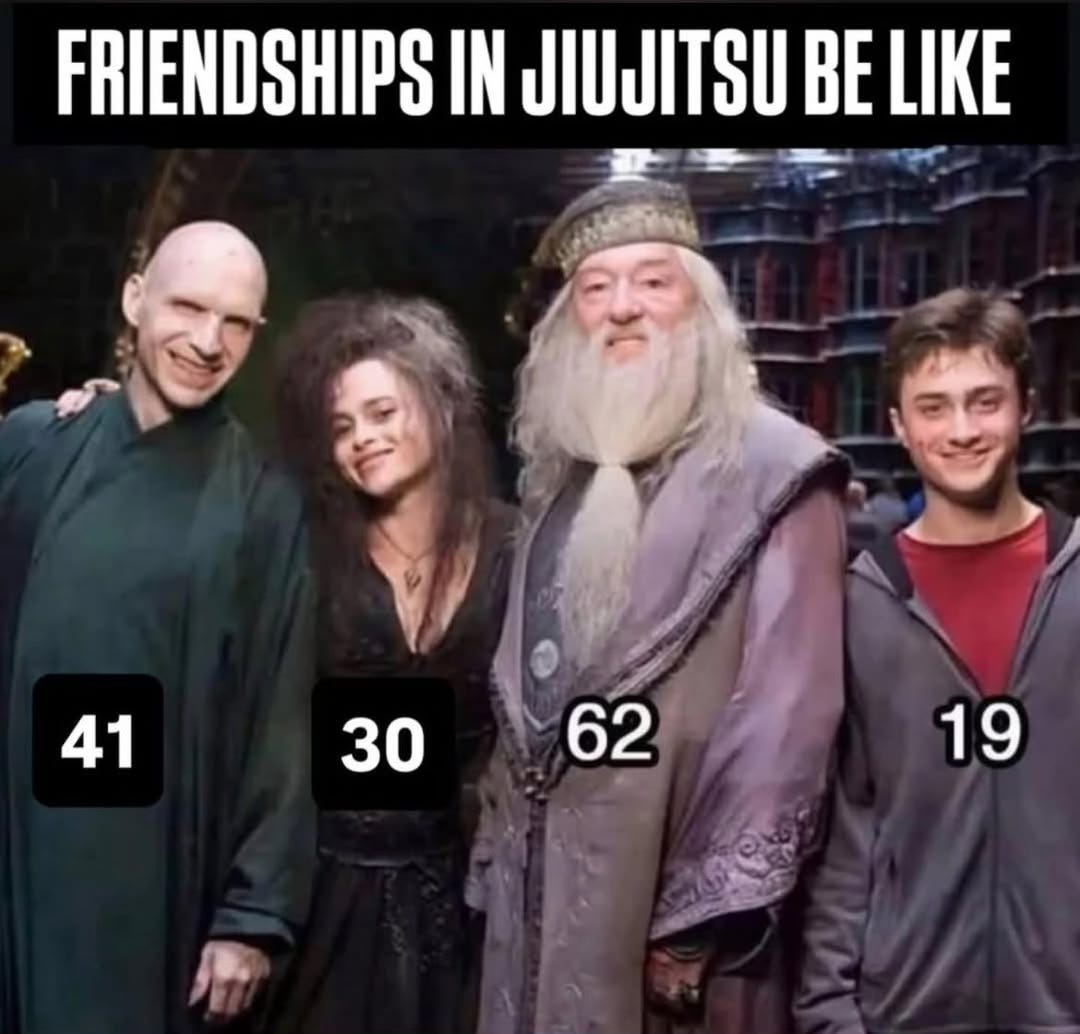
I’ve observed it as I’ve dipped my toes in other passions, too — whether it’s pickleball, climbing, surfing, skateboarding, or music, the dynamic is the same: the shared objective overrides the birth year.
This type of intergenerational mingling feels increasingly rare, particularly in American culture. We are becoming ever more age-segregated.
In Europe, the local pub is often a multi-generational living room (I experienced this firsthand when I lived in Amsterdam in my early twenties). Here, our nightlife and social spaces are often strictly divided by demographic. Fewer of us go to church, which used to be the default “third place” for mixing across generations. Neighborhoods have become less communal; we rarely hang out over the fence with a neighbor of a different generation just to chat.
Which means that for many of us, these “passion containers” — the courts, the mats, the studios — are the only places left where we meet as equals.
And honestly? We are losing something very special. As anyone who has a close friend 20 years their senior (or junior) knows, there is a specific magic to disconnecting your social circle from your birth year.
For younger people, the benefit is obvious: you get a cheat code. You get access to wisdom that isn’t theoretical. You get to spend time with someone who hasn’t just read about the confusion or heartbreak you’re going through, but has actually lived it — and survived it.
Ever since I was a kid, I’ve gravitated toward older friends. I love hearing the stories and the lessons learned, but mostly I crave the perspective. When you’re young, every crisis feels permanent; older friends are living proof that “this too shall pass.”
There also tends to be less of an ego clash. In peer groups, we are often subtly competing for the same mates, jobs, or status. With older friends, that competition dissolves into mentorship. It feels comforting. It feels safe.
But having younger friends is just as important for older people.
First of all, younger friends are batteries. We feed off others’ energy more than many of us like to admit, so being around young people who remind us to play and be curious does wonders for our own sense of aliveness.
Secondly, it breaks the “wisdom trap.” Sometimes, as we age, our wisdom actually gets in the way. We’ve learned so much about “what goes wrong” that we stop taking risks. We stop trying to learn the new sport or the new skill because we think we know the outcome. Younger friends — who are often blissfully ignorant of the risks — pull us out of that tunnel vision.
Finally, there is the science of time. As we age, time seems to speed up because we settle into routines and our brains stop recording the predictable details. But young people are naturally more risk-tolerant. Being around them pushes us to take more risks, too — to try the new sport or the unplanned trip. This injection of novelty means our brains have to pay attention again, so more memories get encoded. This actually increases our perceived lifespan, simply because we are forcing ourselves to remember more of it.
Which brings me back to the beach volleyball court.
When I watched that eighty-year-old woman dig a hard spike out of the sand, I realized that nobody on that court was calculating her birth year. Nobody was treating her with the delicate “respect” we usually reserve for the elderly, nor were they dismissing her.
They were just watching the ball.
In that moment, she wasn’t a grandmother or a retiree. She was a teammate. She was a competitor.
If we want to break out of our age-segregated bubbles — if we want the wisdom of the old and the electric risk-taking of the young — we have to go where the passion is. We have to find the places where the objective is more important than the demographic.
Whether it’s the mat, the court, or the studio, these are the places where time collapses, and we just get to be human together.