

Why You Keep Avoiding the Thing You Actually Want to Do
On taste gaps, logistics traps, and why a spark isn't enough

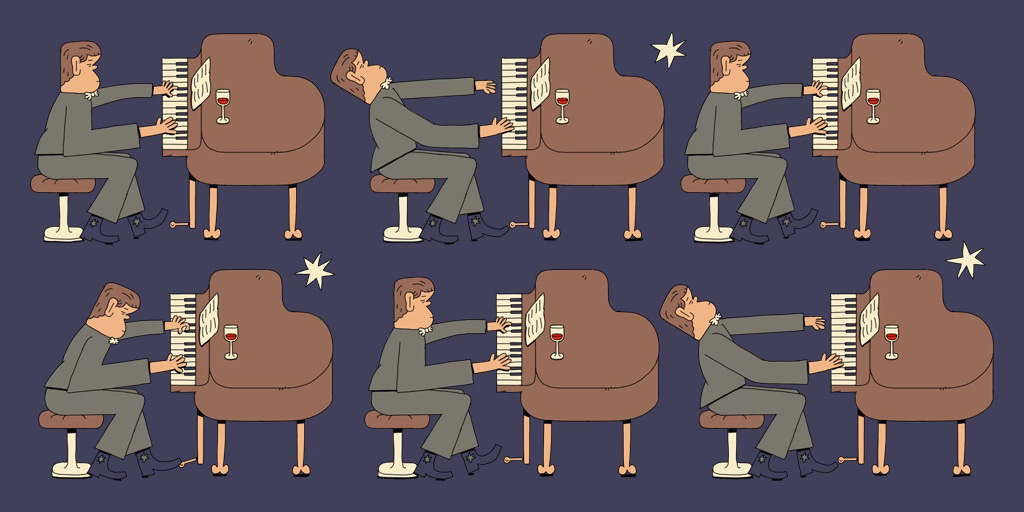
“For the first couple years you make stuff, it’s just not that good... but your taste, the thing that got you into the game, is still killer. And your taste is why your work disappoints you.” — Ira Glass
Every day when I come home, I stare at my keyboard, and a guilty pit forms in my stomach.
It’s impossible to miss. In my small one-bedroom apartment, my keyboard is the first thing you see when you walk in the front door, almost taunting me as I walk in. I’d received it as a gift a year before after declaring to a friend that I just knewI had to learn to play.
It was a spark I can remember feeling as a kid, lingering over my grandparents’ piano (which I was never allowed to touch). That spark stayed with me into adulthood; every time I’d hear a melodramatic melody, something in me would stir. This. I loved this.
And yet, my pursuit has been halfhearted at best — two lessons and a one-month stint on a beginner app. I haven’t progressed past a right-handed “Ode to Joy,” and I’ve caught myself more than once averting my gaze as I walk by.
But the other night, I didn’t. As I was about to look away, I stopped myself. I actually want to play. I have the gear and the interest. So what, exactly, has been stopping me?
I spent a few hours going down sports and behavioral psychology rabbit holes to find out. Because I know I’m not the only one who has experienced this.
So often, we talk about the discovery of something that lights us up as the hard part. Searching for a passion rarely happens like a lightning bolt — more often it takes months, sometimes years, of exposure and experimentation.
But what happens when you’ve found a spark, yet a mysterious barrier keeps you from turning it into a flame?
If you’re staring at your own metaphorical “untouched keyboard,” here is what’s likely going on.
The “Taste Gap”: The Pain of Being a Beginner
The first barrier is psychological. When I imagine myself playing, I’m not pecking slowly at a simplified “Ode to Joy” with the letters written on the keys. I imagine myself playing the Amélie soundtrack — fluid, present, and completely immersed in the music.
This American Life host Ira Glass calls this the “Taste Gap.” It’s the frustrating space where your taste is high, but your skill is non-existent. Whether it’s piano, pickleball, or a new business venture, the gap between your vision and your reality can be cringeworthy. You know what good is, and you’re nowhere near it yet.
Sports psychology offers a solution here: the shift to micro-goals. Olympians don’t focus on the podium four years out during a Tuesday morning drill; they focus on the mechanics of a single movement.
And so, to bridge the gap, you have to shrink the goal until your ego stops hurting. Stop trying to “play the piano” and start “mastering the transition between these three notes.”
The Logistics Trap: The Myth of “Finding” Time
But even if you can tolerate being bad at something, that doesn’t mean you’ll actually do it.
A spark doesn’t mean you’ll naturally make a pursuit a priority. My day is already optimized to my current passions: I write in the morning, train jiu-jitsu in the afternoon, and listen to audiobooks every time I walk my dog, Rocket. Piano currently has no home in my life.
When I used to work mainly with fitness clients, I’d tell them a trick from behavioral psychology: Don’t find time; schedule it.
Treat any new thing you want to build in your life like an important meeting. That doesn’t mean you can’t reschedule it, but when you do so, do so intentionally. Over time, you may not need to be so rigid about it, but when you’re first trying to build something into your life, you need to lock it in before your day just gets away from you.
Or use habit stacking: anchor the new habit to an existing one. For me, that might mean, “After I finish my morning writing, I will play the keyboard for 15 minutes before I go to jiu-jitsu.”
I can’t just stare at the keys and assume desire is enough; I have to solve the logistics first.
The “Dip”: The Pre-Negotiated Quit
Even with micro-goals and a schedule, there’s still one more barrier: the inevitable slog. In his book The Dip, Seth Godin describes the long, unavoidable valley between the beginner’s high and actual mastery. There is always a Passion Dip after the excitement of falling in love with something new.
When I walk past my keyboard, it’s a sign I haven’t fully accepted the Dip. I’m still relying too much on the spark and trying to fast-forward to the mastery phase. I haven’t pre-negotiated the struggle just yet.
Here’s what I mean: In jiu-jitsu, every white belt knows the “Blue Belt Blues” are coming — that grinding middle phase where a black belt feels lightyears away. The ones who make it to purple belt? They’re the ones who decided early on they were going for black belt — no matter what. They made the choice once, so they didn’t have to remake it every time they have a tough training day.
Godin argues that the Dip is actually a useful filter. It weeds out everyone who isn’t serious, which is exactly why pushing through it creates value. But — and I always love this — he also says quitting isn’t failure. Quitting the wrong things frees up time and energy for the right things.
His advice: “Quit the wrong stuff. Stick with the right stuff. Have the guts to do one or the other.”
The key is deciding before you start what your “quit criteria” are. Not if you’ll quit, but under what conditions you will. If you haven’t made that decision, every practice session becomes an agonizing negotiation with yourself: Should I keep going? Is this worth it? Do I really care about this?
But if you decide today that you won’t stop until you can play one full song from the Amélie soundtrack, something shifts. The daily friction disappears. You’re no longer choosing whether to practice; you’re just following through on a choice you already made.
---
Applying these strategies doesn’t mean your pursuit of a passion will suddenly be effortless. In fact, learning anything new should feel like a struggle — that’s how you know you’re challenging yourself. But understanding these barriers makes it more likely you’ll stay patient enough to help your spark grow into something bigger.
The evening I finished researching for this article, I didn’t walk past my keyboard. I sat down, opened the beginner app I’d abandoned months ago, and played through “Ode to Joy” five times. My fingers still fumbled. I kept forgetting which key was which. But something had shifted — I wasn’t trying to skip ahead to the Amélie soundtrack anymore. I was just trying to memorize middle C.
Now, if you’ll excuse me, I have another date with those keys before my next jiu-jitsu training. I am determined to finally move past “Ode to Joy.”
Have you experienced a stalled passion in your own life? I’d love to hear about it in the comments!