

10 Books That Made Me Rethink Everything About Passion
For anyone who's ever felt behind on finding their thing

"The real juice of life, whether it be sweet or bitter, is to be found not nearly so much in the products of our efforts as in the process of living itself, in how it feels to be alive." — George Leonard
According to the cool Notion database I created to finally start tracking my books, I’ve finished 36 books so far this year and am actively reading seven. Safe to say, reading is one of my biggest passions.
Unsurprisingly, books have also shaped how I think about passion itself. What does it take to fall — and stay — in love with something? I’m always looking for more clues.
The books below have offered the most. Some taught me that passion is something we build over time, not something we stumble into fully formed. Others gave me words for what it feels like to be in flow — and how much of pursuing a passion is the slow, repetitive work that no one sees. A few have helped me understand the role of choosing, and quitting, and committing in spite of the fear heartbreak.
I love a good book list, so I want to put these together more often. Here are the ten, in no particular order.
(Titles are linked if you want to explore them. Some are affiliate links — a small, no-cost-to-you way to support the newsletter if you decide to buy.)
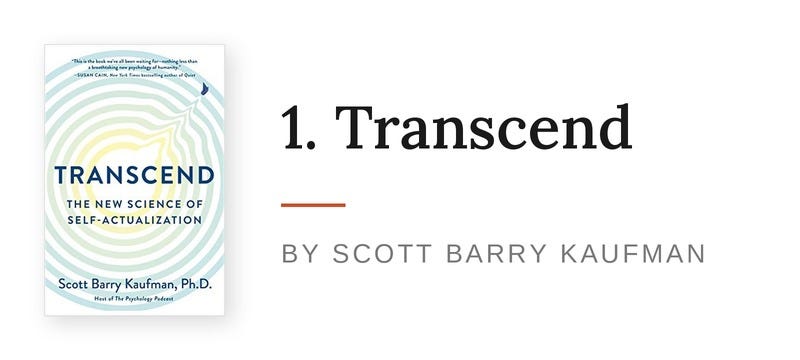
I devoured Transcend just as the world was shutting down for Covid. In it, Kaufman reimagines Maslow's hierarchy of needs — it's more like a sailboat than a pyramid, he says. The boat is our security needs, the things that keep us afloat; the sail is our growth, our exploration, our reaching toward something more. “Life is not a video game where we complete each level and unlock the next until we've reached the top,” he writes.
But what stuck with me wasn’t just the framework. It was one of the first books I read that treated passion as something worth studying — and that, almost by implication, made me start treating it as something I could pursue rather than wait for. Before then, I’d thought of passion as something you either had or didn’t. I felt like a failure for not having found mine. Reading this loosened that idea. Passion didn’t have to fall into my lap. It could be a thing I built.
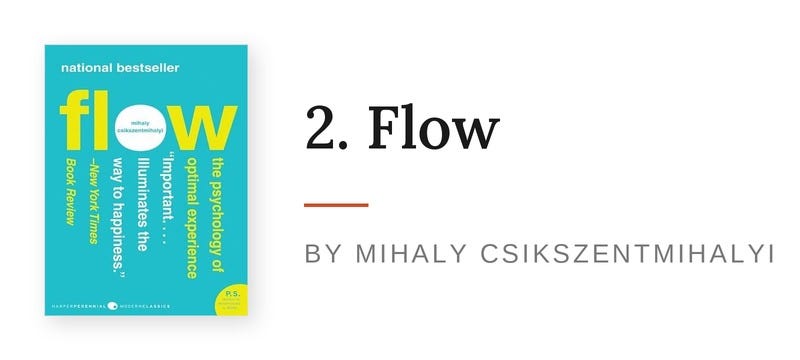
The paradox Csikszentmihalyi spent his life studying: the activities that demand the most from us are the ones that leave us feeling most energized. Flow happens when challenge meets skill, time disappears, and you become completely absorbed in what you’re doing. This book gave me language for something I’d felt my whole life without being able to name. It also convinced me that flow and passion feed each other. If you want to find your passions, one of the simplest things you can do is notice where you already lose time.
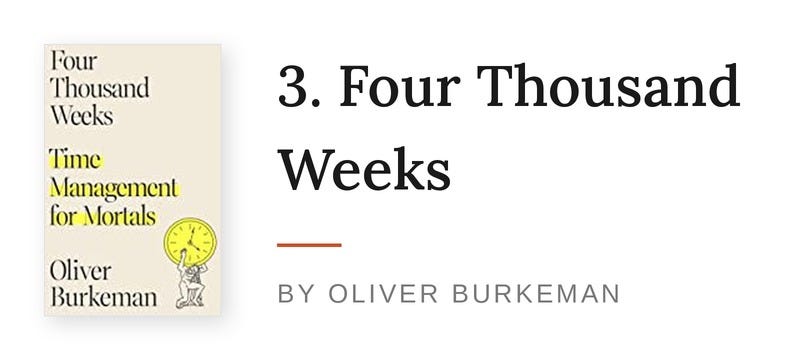
The premise: the average human life is about four thousand weeks (or eighty years) long. Burkeman argues that one of the hardest parts of being human is accepting our finitude — and that the people who refuse to (who keep all their options open, who live in the land of “what ifs”) are the most miserable of all. I think about this a lot when it comes to choosing a passion. We can’t pursue every interest that’s ever pulled at us. The ones we do choose matter more because of it. Read it here.
Waitzkin became a national chess champion as a kid, then a world champion in Tai Chi Push Hands as an adult. This book is about the underlying principles that let him reach the top of two completely different disciplines. (After writing the book, he went on to get a black belt in jiu-jitsu then devote himself to hydrofoiling.)
What stuck with me in this book is how much time and patient, deliberate work mastery actually takes. Outward success isn’t the point — Waitzkin just happens to be a useful extreme case — but the book reminds me just how much passion and mastery are linked. It’s so easy to give up on something when we’re not very good at it yet. Waitzkin is a reminder that commitment, more than the feeling of passion, is what keeps the fire burning.
Leonard was a fifth-degree black belt in aikido who used his decades on the mat as the lens for this short, wise book on what it actually takes to get good at anything. Like Waitzkin, he gets honest about the plateaus — those long stretches where progress feels invisible but the learning is quietly cementing. Leonard doesn’t talk about passion directly, but I think he’d agree with the case I make: passion and mastery are inseparable. The plateau isn’t the obstacle to mastery — it’s baked into mastery. Learning to love it is the work. As Leonard wrote: “It’s not the love of the thing, but the love of the mastery of the thing that sustains you.”
Epstein’s argument: people who sample broadly — picking up skills, frameworks, and curiosities across seemingly unrelated fields — tend to outperform early specialists in the long run, because the work that matters most depends on cross-pollination and pattern recognition between domains. Range is a vindication for late bloomers, generalists, and anyone who’s ever felt like their meandering path was a problem. It also reshaped how I think about passion. We don’t just discover a passion — we become ready for one. What looks like wandering is usually the layers building underneath.
Most worthwhile pursuits involve a long slog between the early excitement and real mastery. Godin calls it the Dip. The people who succeed aren’t the ones who avoid it. They’re the ones who decide, before they hit it, that it’s worth pushing through — and who quit ruthlessly on everything else. This was the first book that gave me permission to quit, which sounds like the opposite of a book about passion until you sit with it. Passion requires focus. We can’t give our hearts to everything. Quitting the things you don’t care enough about is what frees you to go all in on the ones you do.
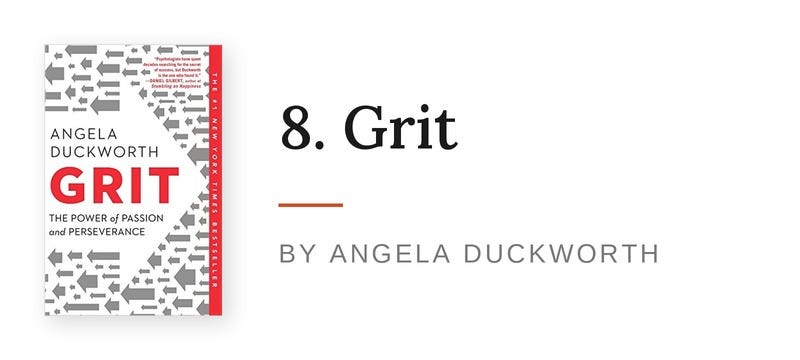
Duckworth’s core argument is that grit — passion and perseverance over the long haul — matters more than talent. That reframe hit me hard when I first read it. Growing up, I thought you were either good at something or you weren’t (it turns out almost nobody is at first). This was also one of the first books I read talking about passion as something we develop, not something we find fully formed — an idea that’s since become central to how I think about it.
The chapter on parenting stuck with me too: she lets her daughters pick any interest they want, but they have to commit for at least six months. Long enough to get past the initial awkwardness of being a beginner and find out if they actually like the thing, not just the idea of it. It’s a rule I now recommend to anyone trying to figure out whether a new interest might become a real passion, no matter what age they are.
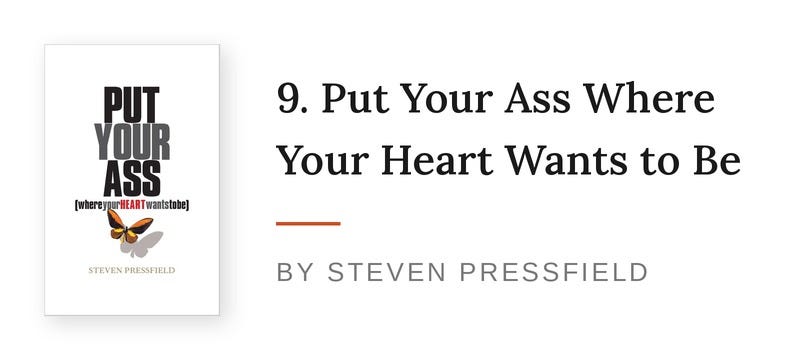
Pressfield’s books always get right to the heart of things, and this one is no exception. His argument is that you can’t pursue a dream — or a passion — without putting yourself physically and emotionally on the line. Showing up is the work. Risk is part of the deal. “Commitment = exposure,” he writes. “That’s why people don’t commit. They’re not stupid. They don’t want to risk falling off the mountain.” But the alternative — never committing, never exposing yourself, never putting your ass where your heart wants to be — is its own kind of pain. There’s no way around it. If you want the passion, you have to take the risk.
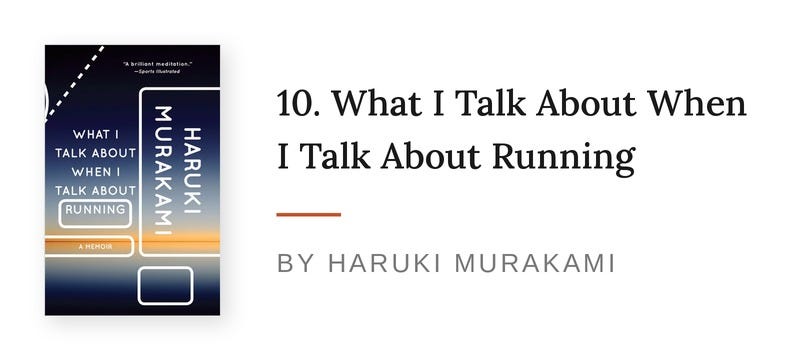
Murakami writes, he runs, he listens to music, and he doesn’t do a whole lot else. This memoir is an account of his long miles of running and long days of writing — a fairly monotonous routine he’s repeated for decades. From the outside it might look boring. From the inside, it’s a life. That’s what makes What I Talk About When I Talk About Running such a powerful illustration of what passion actually looks like over the long haul.
As Murakami puts it: “Most runners run not because they want to live longer, but because they want to live life to the fullest. If you’re going to while away the years, it’s far better to live them with clear goals and fully alive than in a fog… Exerting yourself to the fullest within your individual limits: that’s the essence of running, and a metaphor for life — and for me, for writing as well.”
His words could describe any passion. Or any life.
PS. If you have any book recommendations, please send them my way :)